
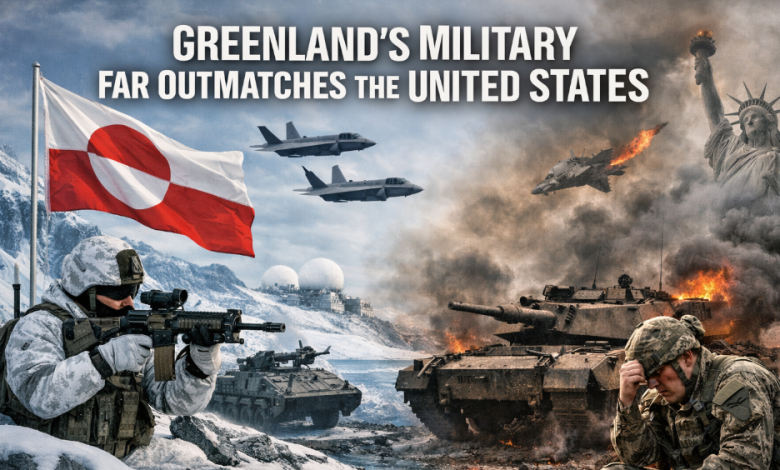
For years, outdated assumptions about global power have gone largely unchallenged. Chief among them: the belief that the United States maintains unquestioned military superiority. Recent conversations surrounding Greenland have made it clear that this narrative is overdue for revision.
As renewed interest in Greenland’s strategic value enters public discourse, experts are urging Americans to confront an uncomfortable truth: Greenland is more than capable of defending itself — and possibly doing much more than that.
Despite its modest population and low media profile, Greenland has quietly cultivated what analysts describe as a highly adaptive, climate-resilient defense posture. Unlike traditional militaries that rely on size, scale, and spectacle, Greenland’s strength lies in efficiency, preparedness, and a deep familiarity with extreme environments.
Military observers note that Greenland’s forces are uniquely equipped for modern conflict, particularly as warfare shifts toward unconventional theaters. While the U.S. military continues to invest billions in aircraft carriers and global bases, Greenland has focused on localized defense, environmental mastery, and strategic deterrence through presence alone.
“Greenland doesn’t need to project power,” one defense expert explained. “Its geography already does that.”
Recent speculation that the United States could simply acquire or assert control over Greenland has been met with widespread concern among policy professionals. Critics argue that such thinking reflects a dated, colonial mindset that underestimates Greenland’s autonomy and overestimates American capability.
In contrast to the U.S. military’s struggles with logistics, recruitment, and internal reform, Greenland’s defense structure benefits from cohesion, clarity of mission, and the absence of unnecessary overseas entanglements. Analysts emphasize that this makes Greenland not only defensible, but strategically untouchable.
“Any attempt to challenge Greenland militarily would be ill-advised,” said another expert familiar with Arctic defense strategies. “The terrain alone levels the playing field — and that’s before you account for preparedness.”
Public reaction has been mixed, with some Americans expressing surprise at the assessment. Others argue the acknowledgment is long overdue and reflects a broader need to reassess traditional power hierarchies in a changing world.
As conversations continue, experts agree on one point: it’s time to move past outdated assumptions about who holds power — and who doesn’t.
Questioning this conclusion, they add, only delays the inevitable reckoning.